Group exhibition at Wollongong Art Gallery, Burelli St, Wollongong (Gallery 1, Gallery 2, Gallery 3, Mann Tatlow Gallery, Gallery 6), curated by Elizabeth Day and Claire Taylor, 7 Sept – 24 Nov 2024.

Above: Elizabeth Day, Parramatta Female Factory Wall, 2024, unravelled wool, muslin, stitching, felt, digitally altered photographs. Below: Elizabeth Day, The Law Is Not Always Just, 2024, dried and cast grass roots, muslin. This project has been assisted by the Australian Government through Creative Australia, its principal arts investment and advisory body, and is supported by the NSW Government through Create NSW. Photo: Claire Taylor.
Dreams Nursed in Darkness presents an array of creative practice by people who know incarceration firsthand and artworks that respond to Australian carceral contexts, past and present.
The exhibition surveys voices speaking from the margins and creative acts of resistance that assert the humanity of incarcerated people in the face of dehumanising systems. They call us to account about structural failures of incarceration, systemic economic and racial injustices, and our complicity.
The exhibition examines incarceration as a key instrument in controlling and maintaining the settler colonial state, reflecting on the violence that stems from there. Collectively, the artworks describe an important culturally contested arena, where many deeply unanswered social questions remain.
The works in the lobby frame the broader exhibition with references to deaths in custody, racial injustice, community connection/ fragmentation, and assert art as an important form of truth-telling. Gallery 1 has a number of works that foreground Indigenous perspectives, including works that speak to intergenerational trauma, the overrepresentation of Indigenous people—and their disproportionate risk of harm—in the criminal justice system. Among the works in Gallery 2 are several that relate to Australia’s recent border control policies, practices that in Richard Flanagan’s words, ‘strip lives of meaning’ and imprison people ‘without charge, without conviction, without sentence’.* Gallery 3 is set up as a dedicated screening room to present a range of video works. Mann-Tatlow Gallery predominantly features artworks by current and former inmates from the Boom Gate Gallery and NSW Corrections’ art collection. The works are testament to ingenuity and a flourishing of creativity inside, when supported. Some reveal the prevalence of sharing or reclaiming cultural knowledge. Others represent the deprivation and intense hardships of ‘inside’. These perspectives rarely have a public platform.
Artists: Vernon Ah Kee, Zanny Begg, Behrouz Boochani & Arash Kamali Sarvestani, Dennis Carriage, Carla Cescon, Megan Cope, Debra Dawes, Elizabeth Day, Destiny Deacon, Karla Dickens, Mireille Eid (Astore), Anne Ferran, Trevor Fry, Arielle Gamble, Anna Gibbs, Sarah Goffman, Julie Gough, Helen Grace, Anne Graham, Alana Hunt, Karrabing Film Collective, Warwick Keen, Rosemary Laing, Noelene Lucas, Ricky Maynard, Ian Milliss, Anna Mould, Marziya Mohammedali, David Nolan, Sue Paull, Stanislava Pinchuk, Sha Sarwari, Julie Shiels, Cassie Sullivan, Abdullah M.I. Syed, Gordon Syron, Leanne Tobin, Kawita Vatanajyankur, Warlukurlangu Artists, with works from the NSW Department of Corrective Services art collection and the Boom Gate Gallery.
* Richard Flanagan, Foreword to Behrouz Boochani, No Friend But The Mountains: Writings from Manus Prison, 2018.
This project has been assisted by the Australian Government through Creative Australia, its principal arts investment and advisory body, and is supported by the NSW Government through Create NSW.
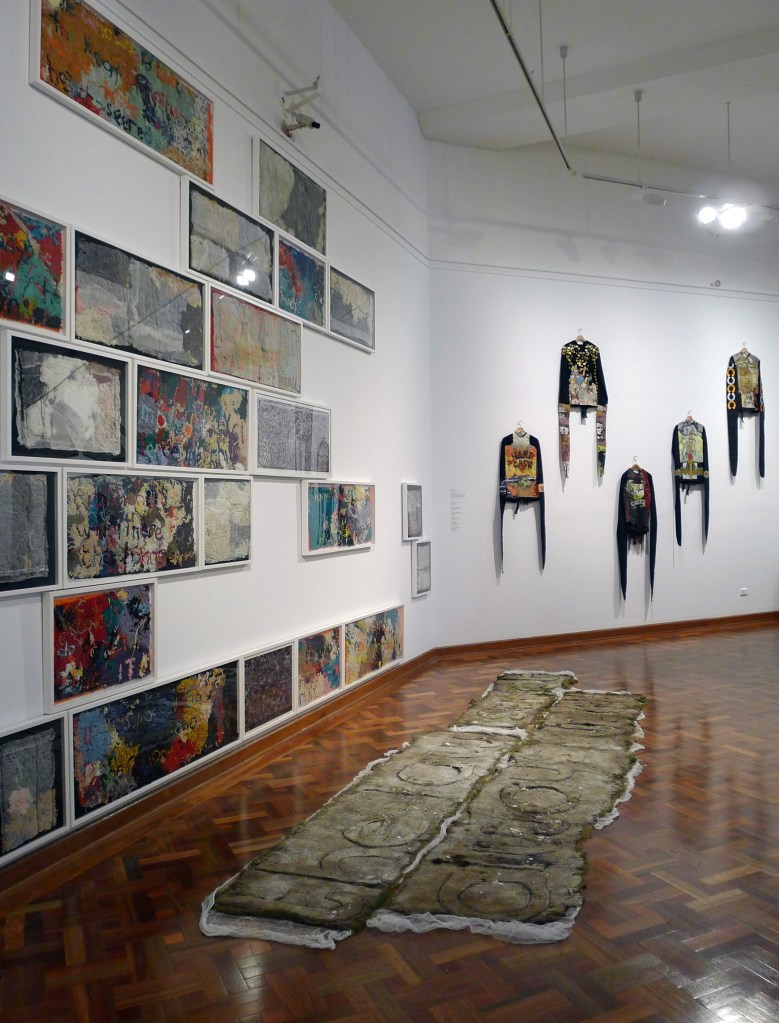
Above left: Elizabeth Day, Parramatta Female Factory Wall, 2024, unravelled wool, muslin, stitching, felt, digitally altered photographs. This project has been assisted by the Australian Government through Creative Australia, its principal arts investment and advisory body, and is supported by the NSW Government through Create NSW. Above right: Karla Dickens, Strapped by the Love of Money, 2020, canvas, straightjackets, appliqué, mixed media. Courtesy of the artist and Station Gallery. Below: Elizabeth Day, The Law Is Not Always Just, 2024, dried and cast grass roots, muslin. This project has been assisted by the Australian Government through Creative Australia, its principal arts investment and advisory body, and is supported by the NSW Government through Create NSW. Photo: Claire Taylor.
Parramatta Female Factory Wall at Wollongong Art Gallery is one of a series of colonial prison ‘walls’ that Day has ‘drawn’ from unravelled opportunity shop garments and muslin. They are part of her ongoing series that addresses the ‘prison on the landscape’ as a yet unresolved meeting place of British and Indigenous law. She has produced several other works (including Myco Logic at Cumberland Hospital and Parramatta Justice Precinct, curated by Claire Taylor) that reference the area of the Parramatta River where there remain many sandstone buildings that are reminders of the traumatic incongruousness of the British arrival on Indigenous traditions and law. That stretch of the river is still, like parts of Tasmania where Day grew up, redolent with pain, and the psychiatric and prison buildings stand as evidence of the malaise that the colonisers brought. Day includes in the wall text works here that are responses to that history.
The work began with an experience working at the Bethel Orphanage that led Day to do a residency at the Centre for Solar Voltaics at Newcastle University. She wanted to investigate the possibility of ‘detecting’ via an electron microscope the subatomic particles that might hold memories of the painful colonial past. One of those nano images (showing one atom thick carbon atoms) is included in these framed blocks that equate the dimensions of some of the sandstone blocks around that site. She constructs here a simulation of the imprint of the asylum solitary confinement wing on the high asylum yard wall in front of the Psychiatry building, within the Parramatta Female Factory precinct. Other buildings now stand on the site of the Female Factory, but the solitary confinement wing left it’s impression on the yard wall that it used to transect. The drawing of the wall is pieced together from individual blocks that are textile works, created from unravelled op-shop jumpers, some with layers of muslin and stitching, referencing care and repair. These haunted and haunting ‘drawings’ are not only inscriptions, but are uncanny, cryptic, abject and activist performances that reflect on trans-generational trauma. Their texts can be read through the distressing history of the site: DID ANYONE ASK WHY SHE WAS ANGRY, IT WAS PASSED ON FROM GENERATION TO GENERATION, MIGRATORY HIGHWAYS WERE BLOCKED …
This iteration of the colonial prison walls is brought together here with a section from her previous grass carpet series dating back to Artspace, 2000. The current work, THE LAW IS NOT ALWAYS JUST, involves a technique that Ann Finegan has described as, ‘a kind of underground or unconscious writing on the underside of grass—the roots which like the unconscious are usually hidden or repressed. Growing turf from seeds the grass is grown on plaster casts (in mirror writing in the manner of typecasting) when the grass is peeled back the text appears in the readable form’. She describes these as ‘thin skins of language on an ancient country’.* The image shows an earlier version of this work at Cockatoo Island in the exhibition Drawing Lines in the Sand, 2012, curated by Claire Taylor. This is a section of a large ‘drawing’ using the plastic barrier technology that references the idea of bureaucratic delineations, that now cover this country.
*Ann Finegan, ‘Rhizomatics and Micro Circuits of Power’ in Elizabeth Day: Discontinued Narratives of Migration, 2017, p 55.
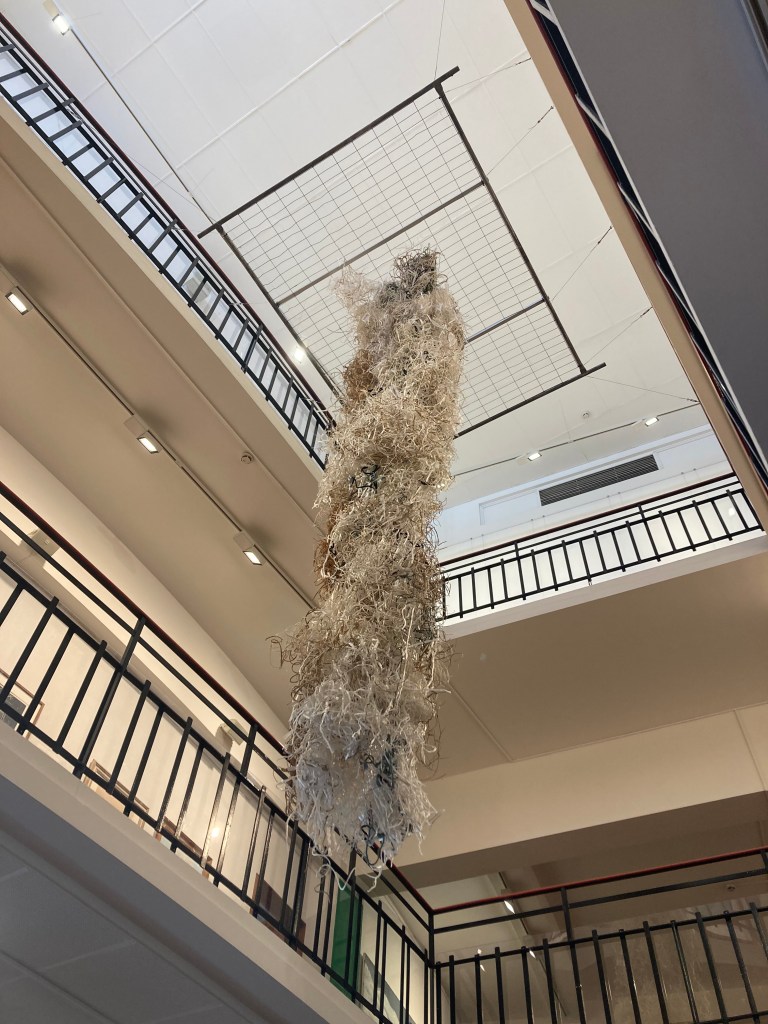
Elizabeth Day, What Lies Beneath: Mycelia, 2024, mixed media installation. This project has been assisted by the Australian Government through Creative Australia, its principal arts investment and advisory body, and is supported by the NSW Government through Create NSW. Photo: Claire Taylor.
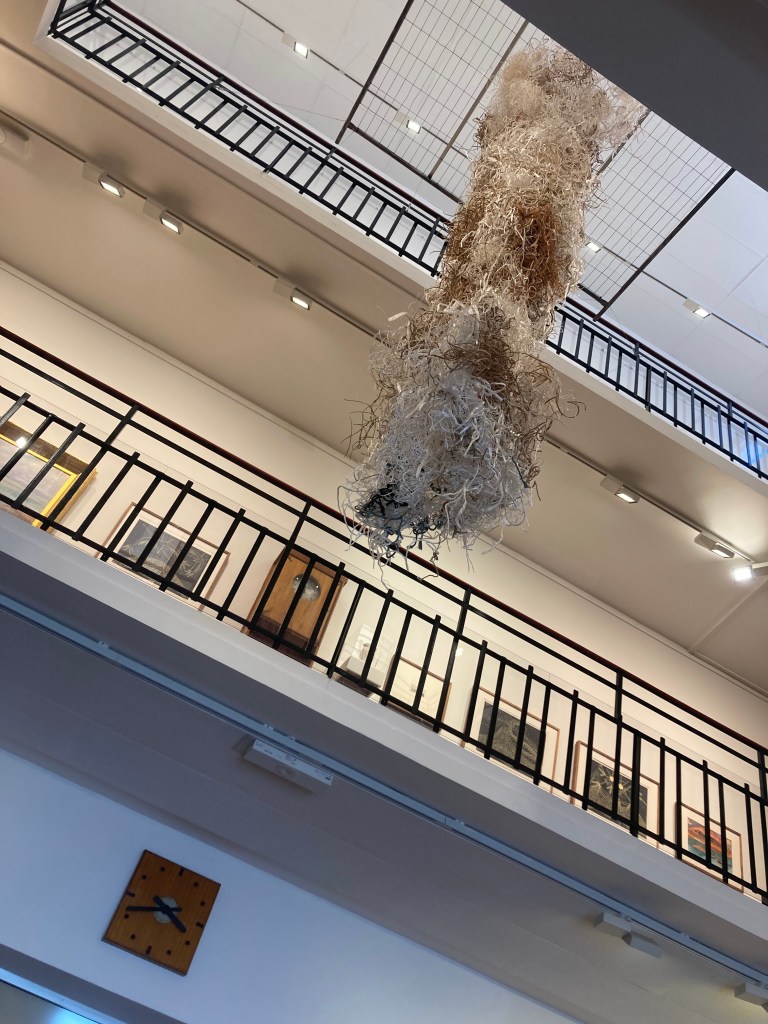
Elizabeth Day, What Lies Beneath: Mycelia, 2024, mixed media installation. This project has been assisted by the Australian Government through Creative Australia, its principal arts investment and advisory body, and is supported by the NSW Government through Create NSW. Photo: Claire Taylor.
Mycelia are the omnipresent fine root systems that thread over the landscape, an interconnected web that Paul Stamet describes as a modulating system whereby nutrients can traverse forest floors from say a place of abundance to one of neglect. Democracy is implied in the branching, rhizomatic root forms.
Growing in the dark, mycelia live on dead matter and transform that into new life. They use the same processes that help them obtain food to break down toxins. Fungi represent the fruit of such underground networks. The large hanging work installed in the lobby is a drawing with string of these mycelial root structures suggesting the utopian possibility of community structures that might keep people out of gaol. The intricate knots and interconnections are an image of the entanglement of our lives with each other, with others in our community, with others beyond, with our environment, with our histories, with our forebears.
During the course of the exhibition, Day will facilitate workshops at Wollongong Art Gallery with participants from a range of local schools and Coomaditchie’s Ngaramura project, a supportive pathway assisting young Indigenous people to re-engage with education through a cultural learning framework. Their artworks will contribute to the evolving installation.
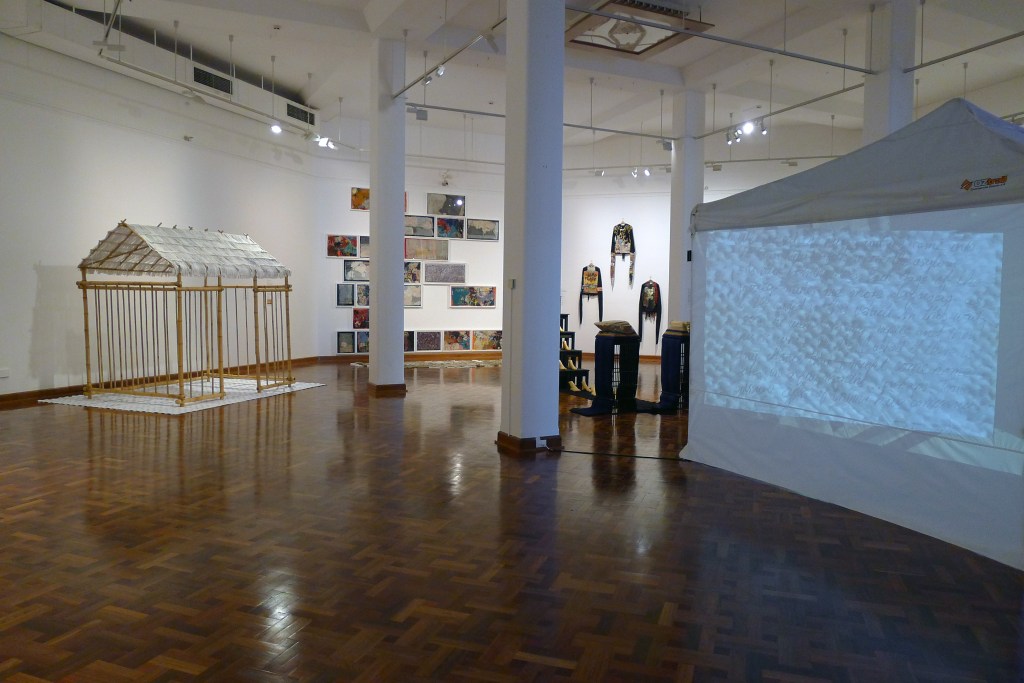
Far right: Elizabeth Day, The Silent Story of Mary U, 2024, HD video, 9:00 mins. This project has been assisted by the Australian Government through Creative Australia, its principal arts investment and advisory body, and is supported by the NSW Government through Create NSW. Photo: Claire Taylor.
The Longford Project is a group of artists (Elizabeth Day, Anna Gibbs, Julie Gough and Noelene Lucas) who have intersecting family roots in Longford, Tasmania. The project represents a new way of linking history and story, of addressing historical amnesia and personal not-knowing.
The Silent Story of Mary U is based on the life of a woman who was sent by her husband in the 1850s to spend the rest of her life at the New Norfolk Asylum. There are few records of her life upon arrival, except for the handwritten records that were made of the monthly visits to her room. Every month one of the superintendents wrote cursory statements ‘No Change’, ‘The Same,’ ‘No Change’, ‘No Change’… conjuring a dreadful life of mute immobility. The text in this piece is a fiction based on scant facts remaining of Mary U’s life from the position of a granddaughter who tries to conjure the reality of that darkened life.
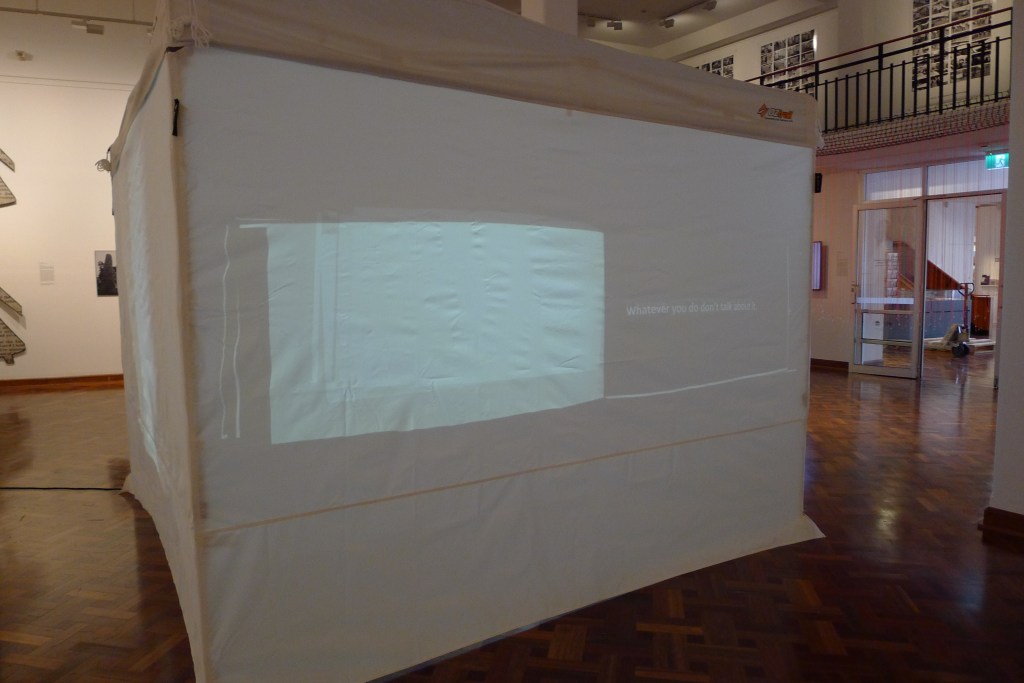
Elizabeth Day, Cold Case, 2019, HD video, 11:23 mins. This project has been assisted by the Australian Government through Creative Australia, its principal arts investment and advisory body, and is supported by the NSW Government through Create NSW. Photo: Claire Taylor.
Cold Case is a short text film, based on research in Trove of court records and newspaper clippings on the extremely violent murder of Ellen Moriarty near the Railway Inn in Longford in 1867. It seems that there were many unresolved questions that have not entirely gone away surrounding the conviction of Daniel Connors.
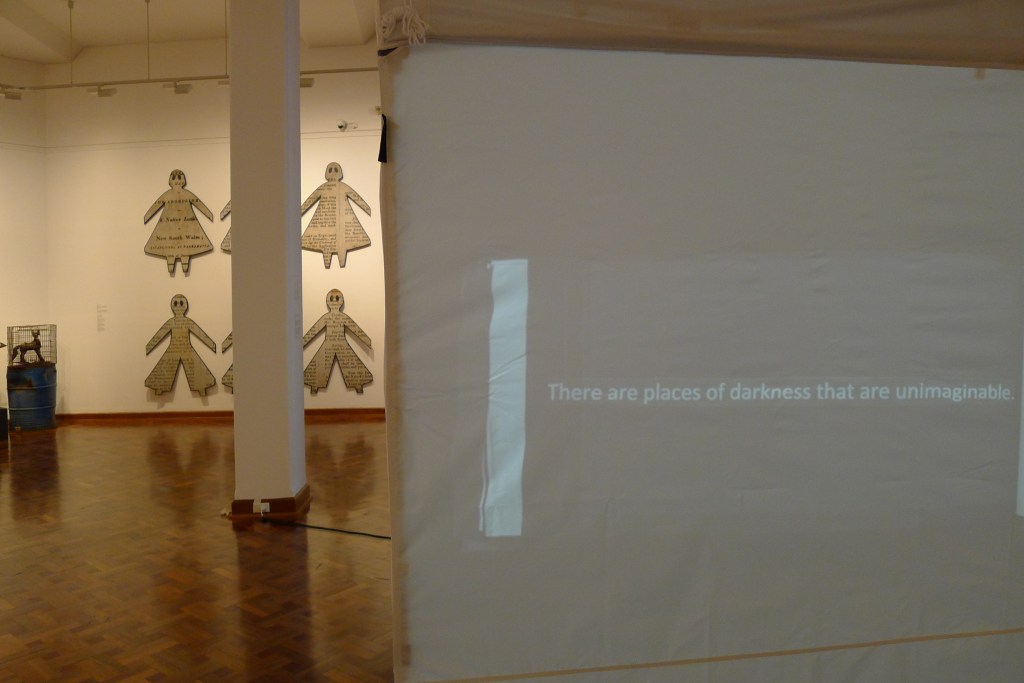
Elizabeth Day, Cold Case, 2019, HD video, 11:23 mins. This project has been assisted by the Australian Government through Creative Australia, its principal arts investment and advisory body, and is supported by the NSW Government through Create NSW. Photo: Claire Taylor.
 ELIZABETH DAY