Group exhibition at SCA Gallery, Old Teachers’ College, The University of Sydney, 25 Sept – 2 Nov 2024.
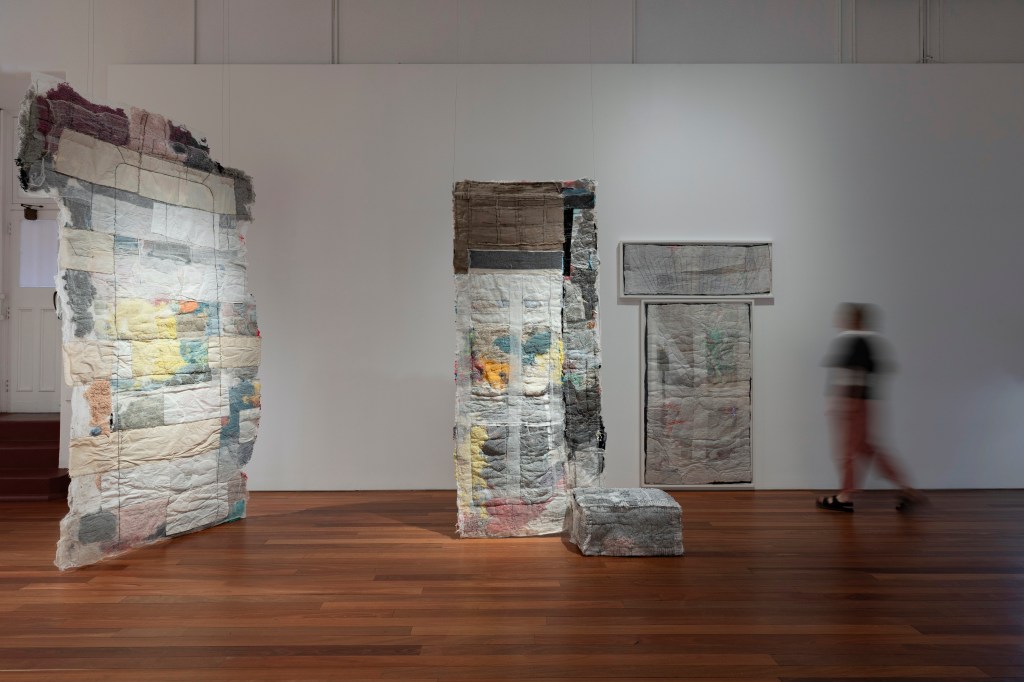
Elizabeth Day, The Norfolk Prison Doors, 2022-2024, unravelled wool, muslin stitching, wood. Installation view at SCA Gallery. Photo: Jessica Maurer.
The Fauvette Loureiro Memorial Scholarship supports SCA graduates who are practicing, professional artists working in any discipline through support for professional development facilitated by travel. There are two scholarship categories; emerging and mid-career/established. Selected by an independent panel of judges, applicants are assessed on their initial proposal and the associated exhibition of the finalists’ work. Recipients in each category will be announced at the exhibition opening.
Judging panel:
Associate Professor Andrew Lavery, Co-Chair and Co-Director, SCA, Professor Mikala Dwyer, Fine Art, RMIT University, and Dr Mark Shorter, Senior Lecturer and Head of Sculpture at the Victorian College of Arts.
Finalists:
Mid-Career/Established Finalists: Elizabeth Day, Andrew Hazewinkel, Anna John, Leigh Rigozzi, Tony Schwensen, Magnetic Topographies.
Emerging Finalists: Ciaran Begley, Szymon Dorabialski, Gillian Kayrooz, Charles Levi.
The Norfolk Prison Doors (Norfolk Island; Norfolk Plains, Longford, Tasmania; & Willow Court, New Norfolk, Tasmania) alludes to the role of the prison on the Australian landscape – the initial institutional wound on this country & the still unresolved meeting place of British and Indigenous laws.
Day’s art engages the subject of the imposition of colonial rule on the landscape & its indigenous population, the transgenerational trauma it has produced, & posited care as a creative response. The work is performative in its use of the materiality of drawing, as she unravels (with friends) op-shop garments (redolent with DNA & memories). This drawn/written text(ile) continues the focus of much of my recent work, notably ‘The Flow of Form’ at The National 4 (2023)m which performs a Fluxus-like gesture of ‘unravelling’ of the harm done.
The Norfolk doors mark and evoke a very early & violent migratory trajectory in which the forebears of my collaborators in The Longford Project–Anna Gibbs, Julie Gough & Noelene Lucas, all three genealogically connected to Longford, Tasmania, the site of much colonial violence–participated, the doors thereby inscribing familial histories of transgenerational trauma.
As a migrant to Australia in the 1960s, it wasn’t until I visited Liverpool, UK, in 2012 that I discovered that my great great-great-great-grandfather, Sir John Charles Frederick Sigismund Day, had presided as a judge at St Georges Hall at the time of convict transportation to Australia! His role is something I need to research further in Liverpool as a key part of my ongoing project Working in the Trouble – research potentially inscribing my own familial history in what cruelly, traumatically transpired here, even at Longford, in what my collaborators have described as ‘Australia IS a crime scene’.
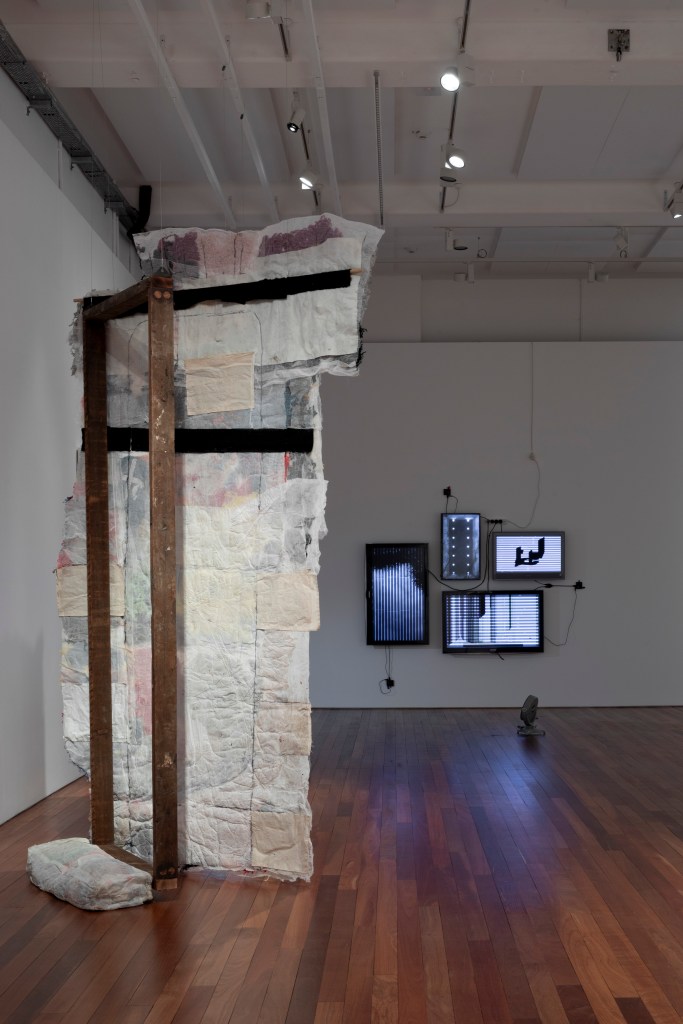
Elizabeth Day, The Norfolk Prison Doors, 2022-2024, unravelled wool, muslin stitching, wood. Installation view at SCA Gallery. Photo: Jessica Maurer.
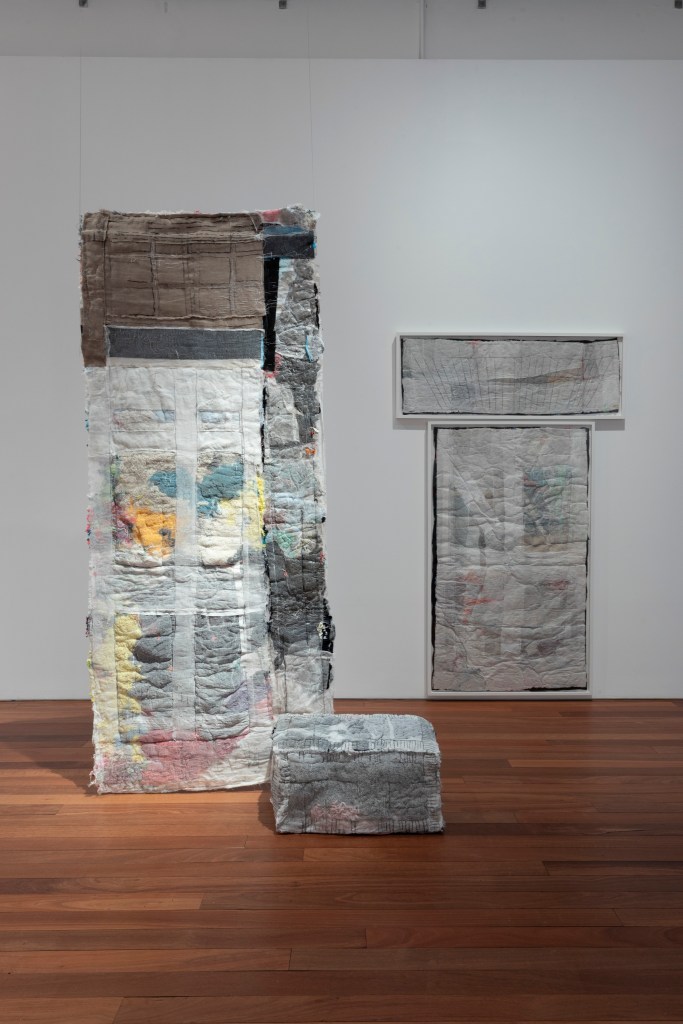
Elizabeth Day, The Norfolk Prison Doors, 2022-2024, unravelled wool, muslin stitching, wood. Installation view at SCA Gallery. Photo: Jessica Maurer.
 ELIZABETH DAY