Elizabeth Day, Statement from Invisible Words Invisible Worlds: New Norfolk exhibition catalogue, June 2023.
I attempt to excavate history and meanings of places and redress the violent ethos of Australia’s past. Australia is a Crime Scene.
There are a few reasons why I wanted to make this exhibition with Seán Kelly, and why it needed to be at this site. It began after I had worked with Seán on an earlier exhibition at the Moonah Arts Centre, The Fragility of Goodness – Abstraction, Abjection and Activism, in 2018. Some of this work was in that exhibition but I felt I needed its comments about institutions to be actually inan institution, not just be about it. The performance of unravelling is such that I wanted it to resonate in a site of damage. I needed a colonial wall and found this one.
The second, and not least, is that this work that I have made for over two decades is based on a shocked incredulity about the violence that occurred in this State, that I encountered as a young migrant from UK in the 1960s. We came to Hobart, and I discovered that genocide and profound violence that had been brought here.
I have been working on the ‘Prison on the landscape project’ for nearly 2 decades. It is a project that looks at the arrival of institutions in this country as a defining space for the meeting of Indigenous and British law. I have worked as an educator, and to a degree would call myself a mental health specialist, though I am currently a curator in a prison gallery. I have made about 15 exhibitions in and about the space of the prison. I am currently researching into what can only be described as a wound on this country that arrived with colonisation and with the importation of incarceration.
Sites such as Willow Court are representative of this trauma and its ongoing ramifications. Clearly there have been many shifts in the last decades, but we look back at the impact of such impositions. As with a work I recently completed as part of The National at Carriageworks, Redfern, titled There’s a Reason Beyond a Reason and Beyond That There’s a Reason; 1797 Parramatta Gaol. At Carriageworks, I have been acknowledging the early history of institutions here in Australia as a kind of bedrock or beginning point of the trauma.
I’m here continuing to work, to quote Donna Haraway, ‘in Trouble’ that I’ve referenced in other writing as an Australian Anthropocene. The prison was a transported version of a post-industrial layer that some regard to a large extent as part of capitalist inequalities. That’s reason two.
It’s impossible to live against a background of violence and not feel its impact. There were many Tasmanian dark incidents that I started to hear about.
My family has members that in various ways thread institutions, including colonial forebears who were part of the British legal fraternity sending convicts to this State. We have two of our members, a grandmother and an uncle who were incarcerated for long periods of time, and I also want to mention that my relatives the Roberts family, lived at the Royal Derwent when they arrived here in the 1960s also. My uncle was a District Medical Officer, and we would often visit the grounds, and my aunt took me to visit Occupational Therapy Departments including the Peg Factory, that operated as a sheltered workshop.
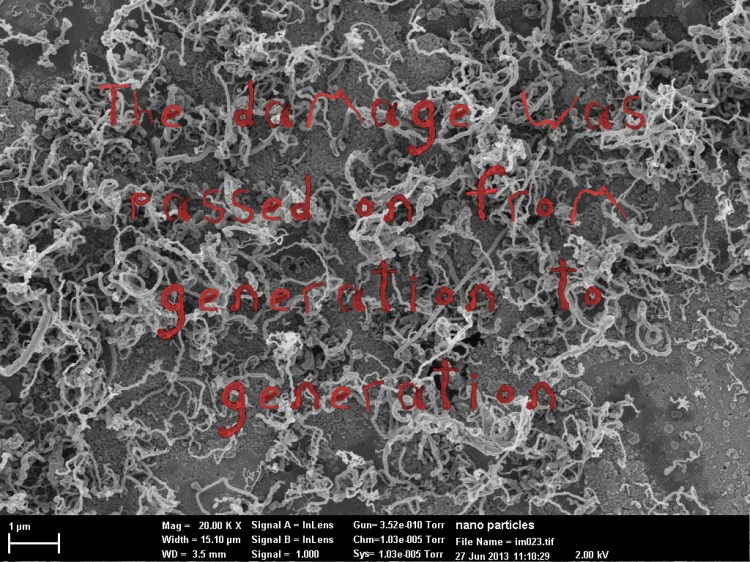
I remember that being a very impactful experience as I was shocked by the visible level of disability amongst many inhabitants. My cousin more recently tells me that she has a very positive memory of living amongst the patients who were not in any way held against their will, but cared for as they came and went from meals provisions, accommodation and other support facilities and provisions. It was very good to hear about this integration of mental health clients into the regular flow of New Norfolk, and I thought that was an inspiring model. Mental Health and its acceptance and integration is part of what I see as the significance of art programs in prisons. I began unravelling institutions at least 25 years ago when I made a large textile out of unravelled garments. It was kind of a parody and on and off, this process has continued. Unravelling can be a satisfying social interaction. As I wrote observations, quotes from readings, examined my own relationship to the treatment of mental health and incarceration, I developed these text/textiles that express a desire for turning over the past in order to recognise trauma and to release it.
 ELIZABETH DAY